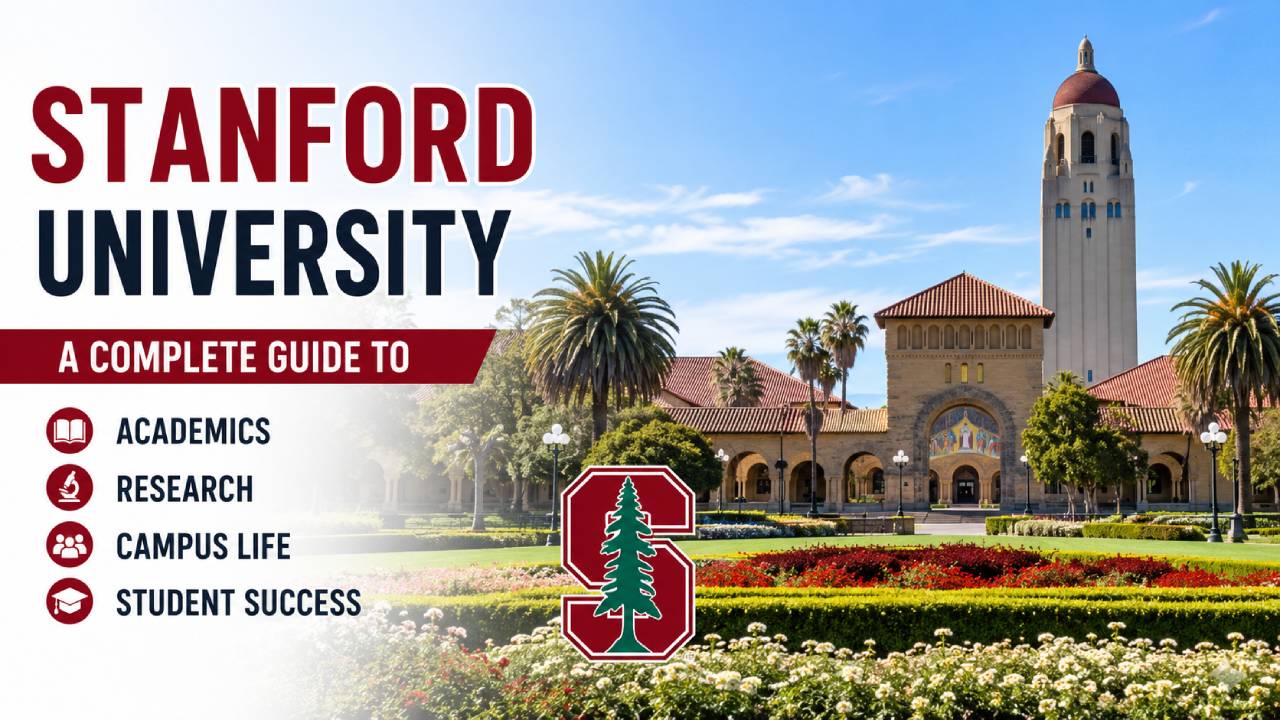
Stanford University is one of the world’s leading institutions for higher education, innovation, and research. Located in the heart of California’s Silicon Valley, Stanford has earned a global reputation for producing groundbreaking discoveries, entrepreneurial leaders, and Nobel Prize-winning scholars.
Established in 1885, the university has become synonymous with academic excellence, technological innovation, and interdisciplinary learning. Its close connection with the technology industry has helped shape companies, industries, and ideas that influence millions of people worldwide.
Whether you’re considering studying at Stanford or simply exploring one of the world’s most prestigious universities, this guide covers everything you need to know.
About Stanford University
Stanford University is a private research university located in Stanford, California. The university is recognized worldwide for its outstanding education, pioneering research, entrepreneurial ecosystem, and commitment to solving global challenges.
Students from more than 90 countries choose Stanford because of its world-class faculty, flexible curriculum, modern research facilities, and vibrant campus community.
Stanford University at a Glance
| Feature | Details |
|---|---|
| Founded | 1885 |
| Type | Private Research University |
| Location | Stanford, California, USA |
| Campus Size | Over 8,180 Acres |
| Student Population | 17,000+ |
| Academic Schools | 7 |
| Global Reputation | Top-ranked worldwide |
| Known For | Technology, AI, Engineering, Business, Medicine |
History and Legacy
Stanford University was founded by Leland Stanford Sr. and Jane Stanford in memory of their only son, Leland Stanford Jr.
Their vision was to establish an institution that would serve humanity through education, innovation, and public service.
Since opening its doors in 1891, Stanford has continually expanded into one of the world’s leading centers for research and higher education.
Major Historical Milestones
| Year | Milestone |
|---|---|
| 1885 | University Founded |
| 1891 | First Students Admitted |
| 1951 | Stanford Research Park Established |
| 1960s | Growth of Silicon Valley Partnerships |
| 2000s | Expansion into AI, Biotechnology, Sustainability |
| Today | Global Leader in Innovation and Research |
Academic Excellence
Stanford emphasizes curiosity, creativity, collaboration, and hands-on learning. Students are encouraged to explore multiple disciplines before specializing in their chosen field.
The university offers hundreds of undergraduate, graduate, and professional degree programs.
Popular Areas of Study
- Computer Science
- Artificial Intelligence
- Engineering
- Business
- Economics
- Medicine
- Law
- Biology
- Political Science
- Psychology
- Environmental Science
Stanford’s Seven Schools
Stanford consists of seven internationally recognized schools.
| School | Primary Focus |
|---|---|
| School of Humanities and Sciences | Arts, Science, Social Sciences |
| School of Engineering | Engineering & Technology |
| Graduate School of Business | MBA & Leadership |
| School of Medicine | Medical Education & Research |
| School of Law | Legal Studies |
| Graduate School of Education | Teaching & Education |
| Doerr School of Sustainability | Climate & Environmental Solutions |
Research and Innovation
Research is at the heart of Stanford’s mission.
Faculty and students collaborate across disciplines to develop solutions for healthcare, climate change, artificial intelligence, cybersecurity, renewable energy, space exploration, and many other fields.
Major Research Areas
- Artificial Intelligence
- Machine Learning
- Robotics
- Medicine
- Genetics
- Climate Science
- Renewable Energy
- Space Technology
- Cybersecurity
- Data Science
Stanford Research Centers
Stanford hosts numerous globally respected research institutes.
Some notable centers include:
- Stanford Human-Centered AI (HAI)
- Bio-X
- Stanford Woods Institute for the Environment
- Stanford Center on Longevity
- Stanford Institute for Materials and Energy Sciences (SIMES)
- Stanford Center for International Security and Cooperation (CISAC)
These centers encourage collaboration among scientists, engineers, physicians, policymakers, and entrepreneurs.
Stanford and Silicon Valley
One of Stanford’s biggest strengths is its location.
Being situated in Silicon Valley provides students with unmatched opportunities for internships, startup creation, networking, and research partnerships.
Many of the world’s largest technology companies have close connections with Stanford graduates and faculty.
Benefits of the Silicon Valley Location
- Startup incubators
- Venture capital access
- Industry internships
- Technology partnerships
- Entrepreneurship programs
- Innovation labs
Entrepreneurship Culture
Stanford has helped launch thousands of successful startups.
Students receive support through:
- Startup accelerators
- Innovation grants
- Business competitions
- Mentorship programs
- Venture funding opportunities
The university encourages students to transform classroom ideas into real-world businesses.
Campus Life
Stanford offers an exciting and welcoming campus experience where students enjoy academic growth alongside personal development.
The campus features beautiful architecture, green landscapes, research laboratories, museums, athletic facilities, and recreational spaces.
Housing and Residential Life
Students have access to comfortable on-campus housing designed to promote collaboration and community.
Housing options include:
- Traditional residence halls
- Apartments
- Graduate housing
- Theme houses
- Family housing
Residential programs encourage leadership, diversity, and lifelong friendships.
Libraries and Learning Resources
Stanford’s library system is among the largest academic collections in the world.
Students enjoy access to:
- Millions of books
- Research journals
- Digital archives
- Study spaces
- Innovation labs
- Research assistance
The Cecil H. Green Library serves as the university’s primary library.
Arts and Culture
Stanford supports creativity through its vibrant arts community.
Students can participate in:
- Theater productions
- Music performances
- Dance programs
- Art exhibitions
- Film screenings
- Cultural festivals
Popular campus attractions include:
- Cantor Arts Center
- Anderson Collection
- Bing Concert Hall
Dining and Student Wellness
Stanford provides healthy dining options that accommodate diverse dietary needs.
Students can choose from:
- Dining halls
- Cafes
- Coffee shops
- Food trucks
- Vegetarian meals
- Vegan options
- International cuisine
The university also offers comprehensive healthcare, counseling, fitness programs, and wellness services.
Athletics and Recreation
Stanford has one of the most successful athletic programs in the United States.
Its teams compete in NCAA Division I athletics across numerous sports.
Popular sports include:
- Football
- Basketball
- Swimming
- Tennis
- Volleyball
- Soccer
- Track & Field
Students also participate in club sports, recreational leagues, and fitness classes.
Student Organizations
There are hundreds of student-led organizations covering every interest imaginable.
Categories include:
- Academic clubs
- Entrepreneurship groups
- Cultural organizations
- Volunteer programs
- Music clubs
- Debate societies
- Robotics clubs
- Political organizations
- Gaming communities
These organizations help students build leadership skills and lifelong friendships.
Global Learning Opportunities
Stanford maintains partnerships with universities and organizations across the globe.
Students can participate in:
- Study abroad programs
- International internships
- Global research collaborations
- Exchange programs
- Service-learning projects
These experiences prepare graduates for leadership in an increasingly connected world.
Community Engagement
Stanford believes education should create positive social impact.
Students regularly engage in community service through:
- Public health initiatives
- Environmental conservation
- Educational outreach
- Community development
- Social entrepreneurship
- Policy research
Programs such as the Haas Center for Public Service encourage civic responsibility and meaningful community engagement.
Famous Stanford Alumni
Stanford graduates have become influential leaders across technology, business, science, politics, sports, and entertainment.
Notable alumni include:
| Alumni | Field |
|---|---|
| Larry Page | Technology |
| Sergey Brin | Technology |
| Reed Hastings | Business |
| Tiger Woods | Sports |
| Sundar Pichai | Technology |
| Peter Thiel | Entrepreneurship |
| Elon Musk (Attended Graduate Program) | Technology & Space |
Admissions and Financial Aid
Admission to Stanford is highly competitive.
Applicants are evaluated based on:
- Academic excellence
- Leadership
- Extracurricular achievements
- Essays
- Recommendation letters
- Personal accomplishments
Stanford also offers generous need-based financial aid, making education accessible to talented students from diverse backgrounds.
Looking Toward the Future
Stanford continues to invest heavily in emerging technologies and interdisciplinary research.
Future priorities include:
- Artificial Intelligence
- Climate Solutions
- Sustainable Energy
- Precision Medicine
- Digital Health
- Space Exploration
- Robotics
- Quantum Computing
The university aims to prepare future leaders capable of addressing complex global challenges.
Frequently Asked Questions
Is Stanford University difficult to get into?
Yes. Stanford is one of the most selective universities in the world, with a highly competitive admissions process.
What is Stanford best known for?
Stanford is internationally recognized for engineering, computer science, artificial intelligence, entrepreneurship, medicine, and business education.
Why is Stanford located near Silicon Valley important?
Its location provides students with exceptional opportunities for internships, startup creation, networking, and collaboration with leading technology companies.
Does Stanford offer financial aid?
Yes. Stanford provides substantial need-based financial aid and scholarship opportunities for eligible students.
What makes Stanford unique?
Its combination of world-class academics, innovative research, entrepreneurial culture, interdisciplinary education, and close ties to Silicon Valley sets Stanford apart from other universities.
Stanford University Highlights
| Category | Highlights |
|---|---|
| Founded | 1885 |
| Campus | 8,180+ Acres |
| Schools | 7 Academic Schools |
| Research | Global Leader |
| Student Life | 600+ Student Organizations |
| Athletics | NCAA Division I |
| Innovation | Silicon Valley Ecosystem |
| Global Reach | Students from 90+ Countries |
Conclusion
Stanford University stands among the world’s most influential institutions for education, research, and innovation. Its commitment to academic excellence, entrepreneurial thinking, and interdisciplinary collaboration has transformed industries and improved lives across the globe.
From pioneering advancements in artificial intelligence and medicine to fostering successful entrepreneurs and global leaders, Stanford continues to shape the future through knowledge, creativity, and service. For students seeking a world-class education in a dynamic and innovative environment, Stanford remains one of the most inspiring destinations for higher learning.